
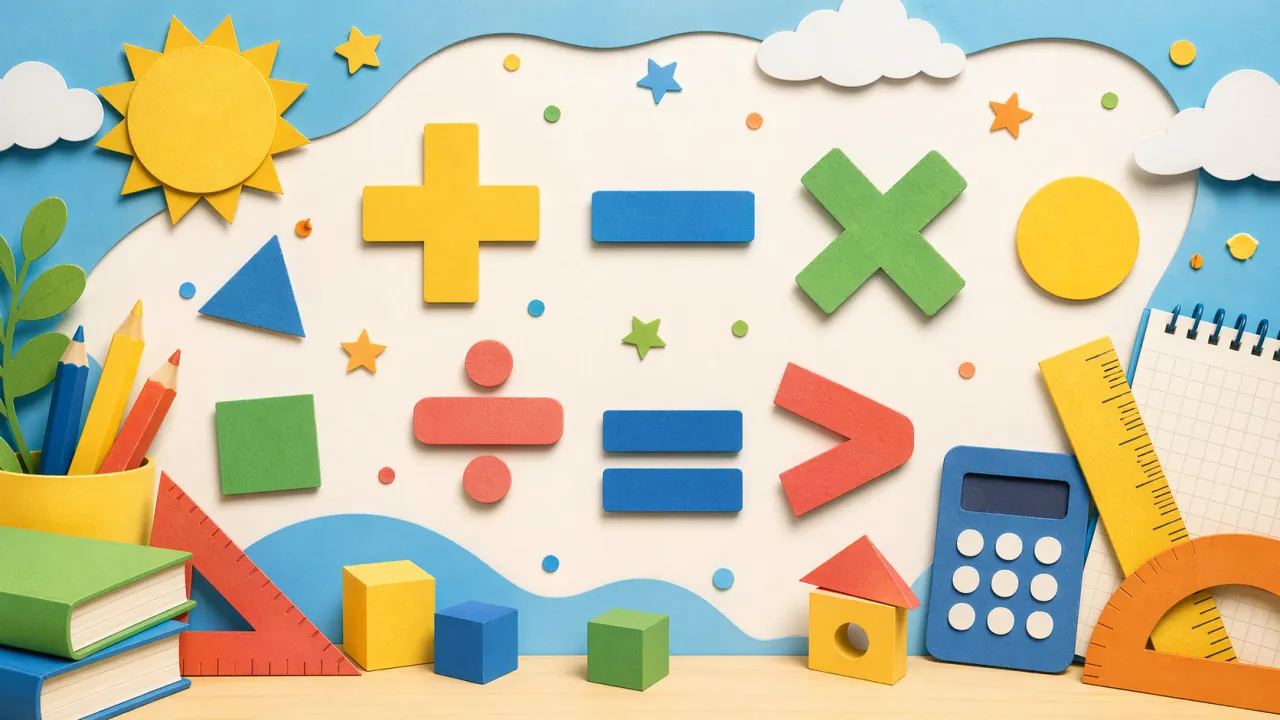
Math symbols are the shorthand of school math. Kids do not need all of them at once. They need the right ones at the right time.
This is a practical list of the symbols most students meet in primary school and middle school, grouped by grade band and by category. Each symbol is clickable to learn more on Wikipedia.
This post was shaped by the broader symbol reference from Math Vault: Compendium of Mathematical Symbols.
Grades 1-3
At this stage, kids mostly need counting, comparison, and the four basic operations.
Number Sentences
Equal sign (=)
Means the values on both sides are the same. Three plus two equals five:
[3 + 2 = 5]
Less than (<)
Means the first number is smaller. Four is less than seven:
[4 < 7]
Greater than (>)
Means the first number is larger. Nine is greater than six:
[9 > 6]
These three carry a lot of early math. If a student can read them comfortably, word problems start to feel less mysterious.
Basic Operations
Plus sign (+)
Means add.
[2 + 5 = 7]
Minus sign (−)
Means subtract.
[9 - 4 = 5]
Multiplication sign ($\times$)
Means multiply.
[3 \times 4 = 12]
Division sign ($\div$)
Means divide.
[12 \div 3 = 4]
Students also see the multiplication sign written as a dot ($\cdot$) in some books, but the times sign is the one most kids meet first.
Place Value And Grouping
Parentheses ( )
Mean do this part first.
[(2 + 3) \times 4 = 20]
Comma (,)
Separates numbers in a list.
[2, 4, 6, 8]
Decimal point (.)
Separates whole numbers from parts. Three and a half:
[3.5]
Parentheses are worth teaching early. They help kids see that math is not just left to right button pushing.
Grades 4-5
Now the work gets broader: fractions, decimals, measurement, and geometry show up more often.
Fractions And Division
Fraction ($\frac{1}{2}$)
Shows parts of a whole. One half means one part out of two equal parts:
[\frac{1}{2}]
Fraction bar or slash (/)
Can also mean division.
[6 / 2 = 3]
Fractions are often the moment when symbols start to feel like a new language. A little repetition helps a lot.
Decimals, Money, And Percents
Percent sign ($\%$)
Means "out of 100." Twenty-five percent equals twenty-five hundredths:
[25\% = \frac{25}{100}]
By this point, students should start seeing that $0.5$, $\frac{1}{2}$, and $50\%$ are different ways to say the same amount.
Geometry Symbols
Angle symbol ($\angle$)
Marks an angle. The angle at point $B$ formed by points $A$, $B$, and $C$:
[\angle ABC]
Degree symbol ($^{\circ}$)
Measures angles. Ninety degrees is a right angle:
[90^{\circ}]
Parallel ($\parallel$)
Means lines that never meet.
[a \parallel b]
Perpendicular ($\perp$)
Means lines that meet at a right angle.
[m \perp n]
Two especially useful geometry facts for this age:
-
A right angle is $90^{\circ}$.
-
Perpendicular lines meet to make a right angle.
Measurement And Approximation
Approximation symbol ($\approx$)
Means "about equal to." Three point one four is close to pi:
[3.14 \approx \pi]
This is a nice symbol for helping kids see that some values are exact and some are close enough for the job.
Grades 6-8
Middle school math adds variables, exponents, ratios, inequalities, and basic statistics.
Variables And Expressions
Variable ($x$, $y$, $n$)
Stands for an unknown number. If two $x$ plus five equals three, then $x$ equals negative one:
[2x + 5 = 3]
[x = -1]
This is where students learn that a letter in math is not a fancy decoration. It stands in for a number.
Powers And Roots
Exponent ($x^2$)
Means multiply $x$ by itself. Five squared equals twenty-five:
[5^2 = 25]
Cube ($x^3$)
Means $x$ multiplied by itself three times. Two cubed equals eight:
[2^3 = 8]
Square root ($\sqrt{x}$)
Asks what number times itself gives $x$. The square root of forty-nine equals seven because seven times seven equals forty-nine:
[\sqrt{49} = 7]
[7 \times 7 = 49]
Ratios, Rates, And Proportions
Ratio ($:$)
Compares two amounts. Two parts to three parts:
[2:3]
Proportionality ($\propto$)
Means "is proportional to," though this usually shows up later in middle school or early high school.
For most students in this band, ratio language matters more than the fancy notation. The fraction form does most of the work.
Inequalities
Less than or equal to ($\le$)
Means the first number is smaller or the same.
[x \le 10]
Greater than or equal to ($\ge$)
Means the first number is larger or the same.
[y \ge 2]
Not equal to ($\ne$)
Means two values are different.
[x \ne 4]
This is the point where students stop solving only one-answer equations and start describing sets of answers.
Coordinate Plane And Graphing
Coordinate pair ($(x, y)$)
Names a point on a grid. Three units right and four units up:
[(3, 4)]
Delta ($\Delta$)
Means change. Delta $y$ means change in $y$:
[\Delta y]
Students may not love graphing at first, but these symbols keep showing up, so it is worth making them familiar.
Probability And Statistics
Mean ($\overline{x}$)
Represents the average of a set of numbers.
Probability ($P(A)$)
Means the chance of event $A$ happening. The probability of heads equals one half:
[P(\text{heads}) = 0.5]
These are not always introduced formally in every middle school class, but they are common enough to recognize.
The Small Set Worth Memorizing First
If a student only memorizes a short list, start here:
Addition and subtraction: +, −, $\times$, $\div$
Comparisons: =, <, >
Fractions and percents: $\frac{1}{2}$, ., $\%$
Geometry basics: $\angle$, $^{\circ}$, $\parallel$, $\perp$
Algebra basics: $x$, $x^2$, $\sqrt{x}$
Inequalities: $\le$, $\ge$, $\ne$
That set covers a surprising amount of school math.
A Good Way To Teach Them
Do not teach symbols as a vocabulary quiz. Teach them inside real problems.
For example:
-
Three plus four equals seven teaches addition and equality together.
-
Five is less than eight teaches comparison with a concrete fact.
-
One half of ten is five teaches a symbol and an idea at the same time.
-
$x$ plus two equals nine teaches that a letter can hold a missing value.
Kids usually learn symbols faster when the symbol solves a problem they already care about.
Final Thought
Most math symbols are not hard. They are just unfamiliar.
Once a student learns to read <, $\sqrt{x}$, or $\angle ABC$ without pausing, math gets lighter. Less decoding. More thinking.